About the Tree
The Rainbow World Fund (RWF) World Tree of Hope® is the largest origami-decorated holiday tree in the world, traditionally standing over 22 feet tall and adorned with over 20,000 origami cranes and stars, each hand-folded and inscribed with wishes for the future of the world. The RWF World Tree of Hope is created each year as a symbol of global unity, promoting peace, love, and humanitarianism. The Tree is a gift from the LGBTQ+ and friends community to the world.
The Tree will be displayed at Grace Cathedral in San Francisco from December 1, 2026, to January 9, 2027. This year marks the twentieth anniversary of the Tree.
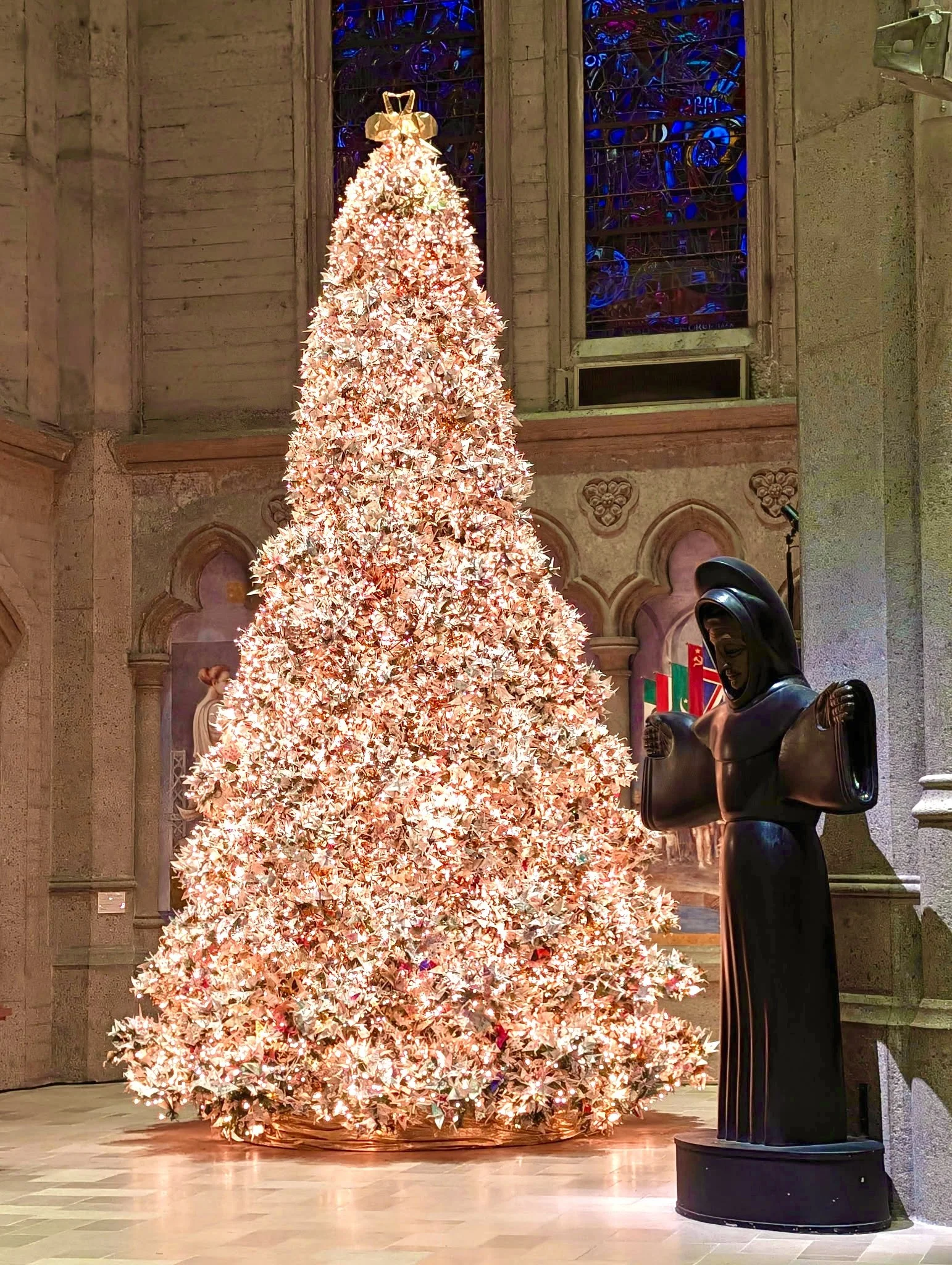
World Tree of Hope 2025
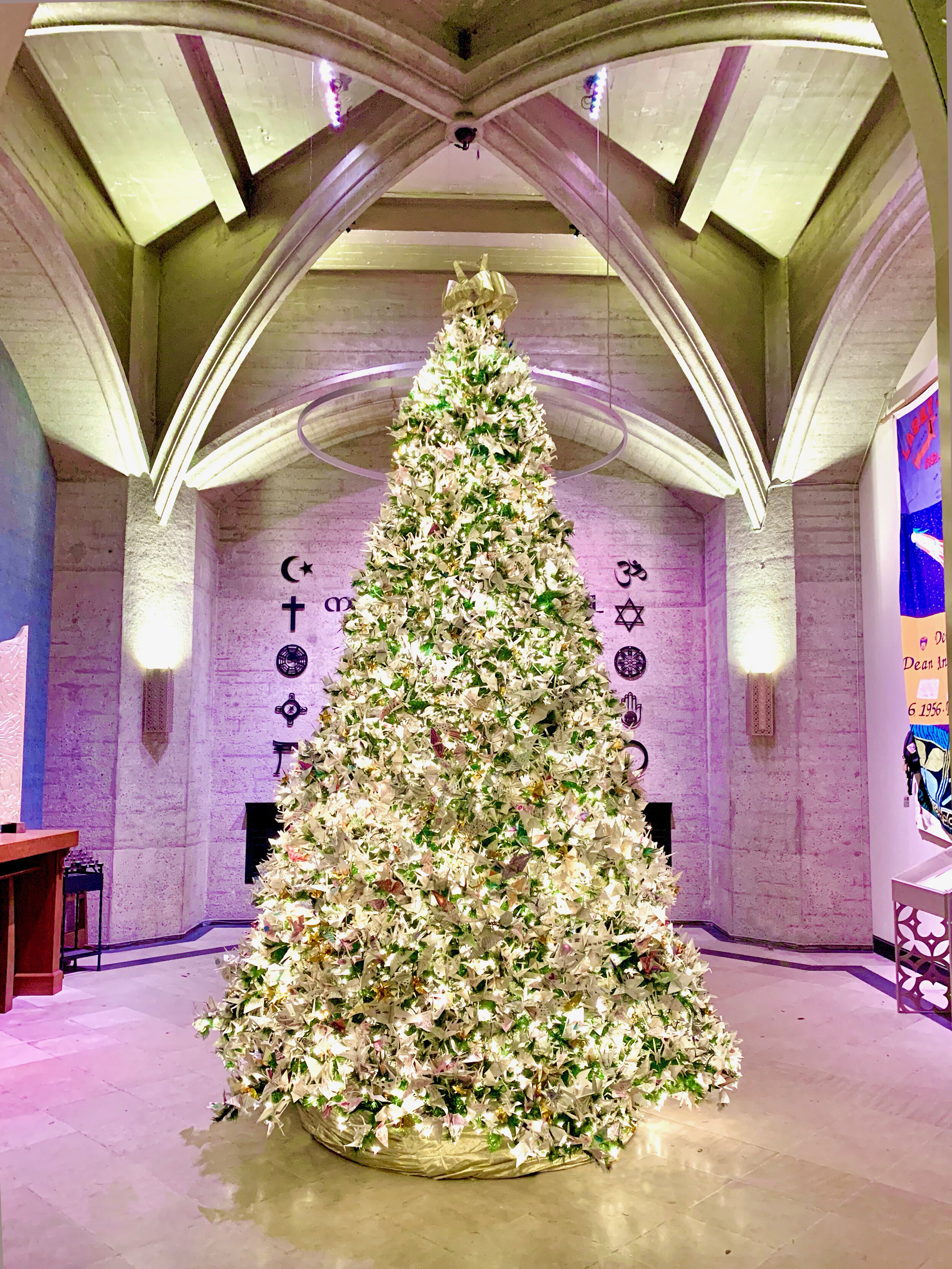
The 2020 World Tree of Hope in the AIDS Memorial Chapel at Grace Cathedral in San Francisco

The 2018 World Tree of Hope at Grace Cathedral in San Francisco.
Designed as the world's most unique holiday tree, people worldwide can help decorate the Tree by simply sharing their wishes for the future. At the invitation of Rainbow World Fund, wishes are sent in by mail and online at http://www.worldtreeofhope.org. The wishes are then printed and folded into origami cranes by a highly diverse team of volunteers, including members of San Francisco's LGBTQ+ and Japanese American communities, survivors of the Hiroshima atomic bomb, local children, and life-sentence prisoners from San Quentin. The origami "crane wishes" are then placed on the Tree. Over three hundred people come together, donating over 2,500 hours to create the Tree.
Notable wish contributors include: President Barack Obama, Secretary of State Hillary Clinton, Dame Jane Goodall, Congresswoman Nancy Pelosi, California Lt. Governor Gavin Newsom, San Francisco Mayor Ed Lee, Frances Moore Lappe, Arianna Huffington, Mariela Castro, Isabel Allende, Shirley Temple Black, Jane Elliot, and Courtney Cox. Many children also contribute wishes to the Tree. See sampling of wishes at http://www.worldtreeofhope.org/celebrity-wishes. With so many people coming together to create the Tree, it is easy to understand why it is dubbed by many as "the people's tree"
RWF created the first Tree of Hope in 2006, which was displayed at Mayor Gavin Newsom's request in the Rotunda of San Francisco City Hall. The Tree of Hope was renamed the Rainbow World Fund (RWF) World Tree of Hope in 2010 in recognition of the global response to the project. The Tree has the distinction of being the world's largest annual origami tree, and in 2010, it was named by American Express Traveler as number three of the Top Ten Christmas Trees in the world. The Tree was displayed at San Francisco City Hall for eleven years before moving to Grace Cathedral, where it continues to be seen by thousands of visitors from around the world. This year's Tree will be on display from December 1, 2026, to January 9, 2027.
Although Grace Cathedral graciously hosts the Tree by allowing Rainbow World Fund to display it there, the Tree is created as a symbol of global unity and universal love; its purpose is purely humanitarian, with the message that we are all one human family. It is open to everyone regardless of belief or nonbelief.
"The RWF World Tree of Hope is an exciting community project and a chance for the City of San Francisco's compassion to be seen and heard throughout the world, promoting peace and humanitarianism." - Mayor Gavin Newsom (2004 -2011).

RWF Board member Karen Kai decorates the 2013 RWF World Tree of Hope.
TThe Rainbow World Fund World Tree of Hope is created to inspire hope and encourage people to think about what they would like for the future of the world. The project recognizes individuals' desire to participate in the global community. It offers people from all over the world a way to come together and express their hopes and intentions. Through developing the Tree as an international art project and teaching tool, participation encourages individuals to experience the power of creation and individual action. During the final art display, the general public and RWF World Tree of Hope participants see the impact of how each crane, together with those of many others, can be transformed into something beautiful—beyond the scope of one individual's efforts.
"The Rainbow World Fund World Tree of Hope joins together individuals of diverse cultures, points of view, spiritual beliefs, socioeconomic backgrounds and sexual identities, and taps into two of our most powerful resources – the human mind and heart – to give individuals a way to join together to express our hopes and intentions for the future of our global community." – Jeff Cotter, founder, Rainbow World Fund
The project also challenges people to get more involved and turn their intentions into action to help heal the world by supporting a variety of projects that are making a difference.
The tree is inspired by the story of Sadako Sasaki, the little girl whose journey and death several years after the bomb was dropped in Hiroshima, transformed the crane into a symbol of world peace. In 1955, the folded crane became known as a symbol of peace when the world learned the story of Sadako Sasaki. Sadako was two when the atomic bomb was dropped on Hiroshima. She was home, about one mile from ground zero. Several years later, she developed the disease of the bomb – leukemia. While in the hospital, a friend brought her an origami crane and taught Sadako the Japanese legend that folding 1000 cranes grants a wish. Sadako started folding but grew weaker with time and passed away 356 cranes short of her goal. Her classmates folded the rest. All 1000 were buried with Sadako. On the wings of the cranes, Sadako would write messages. One deeply profound message read, "I will write peace on your wings and you will fly all over the world." Her hope, strength, and determination have inspired millions.
Rainbow World Fund's (RWF) mission is to promote peace, unity, and hope by leading the LGBTQ+ (gay, lesbian, bisexual, transgender, queer) movement in participating in local and humanitarian relief efforts. Founded in 2000, RWF is the world's first and only all-volunteer, LGBTQ+ based humanitarian aid nonprofit. RWF works to help people affected by natural disasters, hunger, poverty, disease, oppression, and war by raising awareness in and funds from the LGBTQ community to support relief efforts around the world. RWF provides a united voice, a significant, visible presence both in the United States and abroad, and a proven structure to deliver LGBTQ+ charitable assistance to the broader community. We are dedicated to providing aid wherever it is needed, regardless of race, religion, politics, gender identity, or sexual orientation. RWF has provided thousands of volunteer hours for projects such as educational programs, water access and food supply programs, and refugee assistance. Learn more at http://rainbowfund.org.
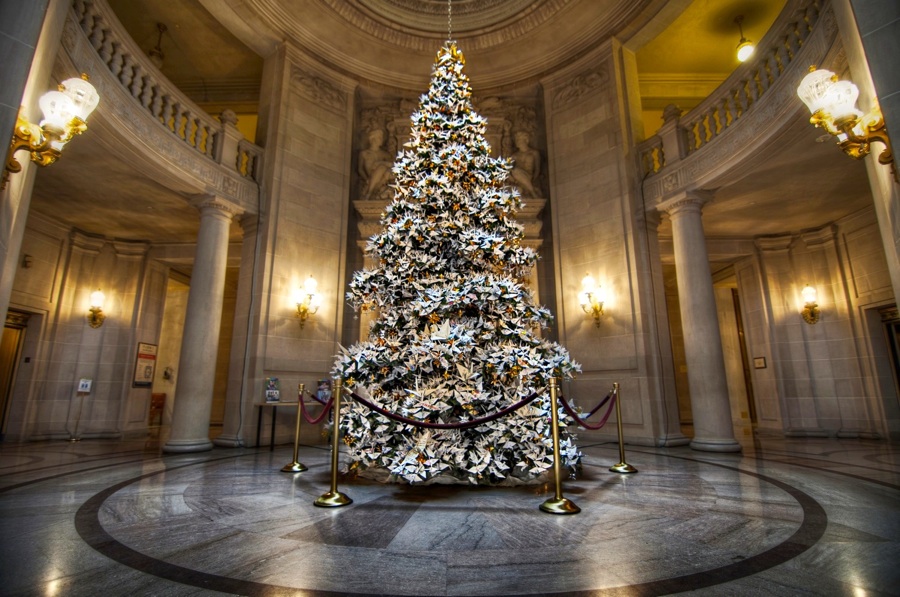
2012 World Tree of Hope in the Rotunda of San Francisco City Hall.
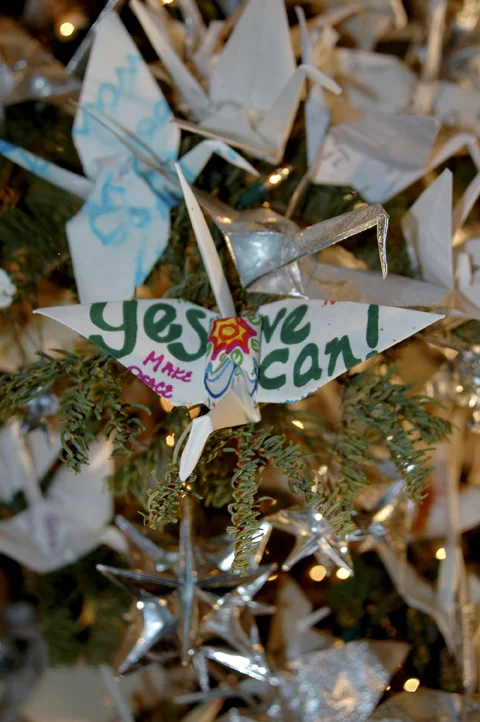
A "Yes We Can" crane - one of the thousands of cranes on the tree.
Creators of the World Tree Of Hope

The creators of the World Tree of Hope, Jeff Cotter, Linda Mihara, Karen Kai, Paul Stankiewicz with San Francisco Mayor Ed Lee (center).
Jeffrey A. Cotter, Founder-President, Rainbow World Fund. A native of the United Kingdom, Jeff founded Rainbow World Fund in 2000, driven by his desire to make a difference in the world. He wanted to tap into the LGBTQ+ community’s strength to help others and change the public’s misperceptions of LGBTQ+ people. A psychiatric social worker specializing in trauma recovery and HIV/AIDS case management. He practices in San Francisco, California. Jeff has worked in the fields of HIV/AIDS and LGBTQ+ civil rights since 1987. (World Tree of Hope 2006 to present).
Karen N. Kai, RWF Board Member. An independent research and writing consultant, Karen is a community activist who has served on the boards of local, statewide, and national Asian American, civil, and human rights organizations. She is a former Chairperson of the San Francisco Human Rights Commission and served as co-chair of its LGBT Advisory Board. (World Tree of Hope 2006 to present).
Linda Tomoko Mihara is a third-generation Japanese American who began folding origami at age 5. She learned the art of paper folding from her grandfather, Tokinobu Mihara, author of Origami, Japanese Art of Paper Folding, vol. 1 and 2, two of the first origami books printed in English in the late 1950s. In 1994, her lifelong fascination with origami led to her design of the ‘Peace Sphere’, a three-dimensional globe of 18 cranes folded from a single sheet of paper. In addition to her discoveries in the connected cranes technique, Linda is known for her sembazuru (1,000 cranes) designs. Linda partnered with Dr. Robert J. Lang on numerous projects, including TV commercials for Mitsubishi and Febreze. In 2008, Linda curated TRANSFORMING KAMI, The Art of Origami exhibits at the National Japanese American Historical Museum. (World Tree of Hope 2006 to present).
Keiko Kubo Keiko is a sansei – third-generation Japanese American, born and raised in Detroit. Keiko has volunteered with the World Tree of Hope for several years. She teaches Sogetsu Ikebana at the Japanese Senior Center in Emeryville. Keiko has been an activist in the Asian Community and with the American Friends Service Committee for many years, most recently with the Third World Coalition and Tsuru for Solidarity. (World Tree of Hope 2014 to present).
Paul Stankiewicz divides his time between luxury retail, helping people get what they desire, and RWF, helping people get what they need to survive, live, and thrive. As co-creator with Cotter of The World Tree of Hope, he worked hard to make RWF more visible in the LGBT and friends community. (World Tree of Hope 2006 to 2010).
Vicky Mihara-Avery, specializing in Origami and Japanese paper arts, has lectured on "Tsutsumi," the Japanese art of gift wrapping, at the Asian Art Museum and the California Academy of Sciences, and on the Martha Stewart Show and Good Morning America. She has provided paper-craft services to clients such as Industrial Light & Magic, Visa International, and Dr. Dobb's Journal. Her production company, Origami Workshop, has produced three instructional DVDs, including The Art of Japanese Gift Wrap and Origami Fun For Kids. Vicky is one of the founders of the Pacific Coast OrigamiUSA Conference and was awarded the Michael Shall Volunteer Award from OrigamiUSA for her contributions to the continuing growth of origami in America. (World Tree of Hope 2006 to 2019).
June Sakamoto began folding origami at age 7. Her many accomplishments in the field of origami include designing and creating the Origami Holiday Tree from 1999 to 2006 at the American Museum of Natural History in New York City. She has appeared on numerous television programs teaching origami, including the Martha Stewart Living Show. She was the recipient of the "Golden Box Pleat Award" in 2005 for her international contributions in Origami, and of the "Michael Shall Award" in 2005 for her volunteerism in bridging East/West relations. (World Tree of Hope 2006 to 2013).

The 2008 World Tree of Hope with a bust of slain LGBT civil rights leader Harvey Milk in the background.
Quisque iaculis facilisis lacinia. Mauris euismod pellentesque tellus sit amet mollis.